CEC enclosure processor core problem. One or more cores
have been deconfigured. Errors that call this MAP normally occur only
while running View storage facility state (end of call), CDA pre-verify,
or CDA code load.
MAP4095 Section-1
Procedure
Are you in the middle of a processor upgrade MES that changes
the CEC enclosure processor module(s)?
The processor module(s) in the first CEC enclosure have
been upgraded and the processor module(s) in the second CEC have not.
There is a processor module mismatch between the two CEC enclosures.
Find the SRC in the serviceable event that sent you here.
Read the MES to determine if a CEC enclosure processor mismatch
error is expected and should be ignored.
Read the SRC definition to see if it says there is a processor mismatch. This might be
normal.
Display open serviceable events to see if there are any other
serviceable events that include processor modules in the FRU list.
If there are, use that serviceable event to repair the problem.
Display open serviceable events for the CEC enclosure. Other than the serviceable event that
sent you to this MAP, is there any other related open serviceable event that lists the processor
modules as FRUs?
Yes, exit this MAP and repair the related serviceable event. If the repair is successful,
remember to close the serviceable event that sent you here. If you were doing a processor upgrade
MES, exit this MAP and continue the MES now.
No, go to the next step.
Does the serviceable event FRU list that sent you here include one or more processor modules to
be replaced?
Yes, exit this MAP and return to the FRU list. Replace the listed processor module(s). If it
still fails, return here and continue to the next step.
Exit the MAP to return to the screen that sent you here.
To the question, "What was the result of using the service procedure?" Click Problem
not fixed and then click Next.
To the question, "Did you exchange any parts?" Click No and then click
Next.
To the question, "Did you isolate the problem?" Click No and then click
Next.
The next FRU in the list is displayed (the processor module or modules). Replace the listed
processor module(s).
No, go to the next step.
Log in to the ASM menu for the failing CEC enclosure.
To determine the CEC enclosure that is failing, observe the FRU location code for the processor
module in the serviceable event FRU list.
Type admin in the User ID field and admin2107 in
the Password field. If the login fails, log in as admin with a password of
admin210.
Display the error and event logs to determine any related problems.
Select System Service Aids > Error/Event logs.
Display the log details and look for information that is related to processor module or
processor core errors or locations.
Are there any logs that identify a failing processor module or processor module core?
Yes, if you can determine the failing processor module FRU, exit this MAP and use Storage Facility Management > storage facility > Exchange Parts to replace the processor module.
No, go to the next step.
Display the processor deconfiguration status.
Select System Configuration > Hardware Deconfiguration > Processor Deconfiguration. The total processors, configured processors, and deconfigured processors are
displayed.
Compare the total processors for the failing CEC enclosure to the working CEC enclosure. Are
there any differences between the number of processors?
Yes, go to the next step.
No, exit this MAP and contact your next level of support. The serviceable event that sent
you here indicates a processor problem was detected, yet all processors appear to be
available.
Display the details.
Click the radio button of the Processing Unit.
Click Continue. The status and location code for each processor ID is
displayed.
Are any processor IDs deconfigured?
Yes, go to the next step.
No, exit this MAP and contact your next level of support. The serviceable event that sent
you here indicates that a memory problem was detected, yet all memory appears to be
available.
Is the CEC that is being repaired in a 242x Model 961?
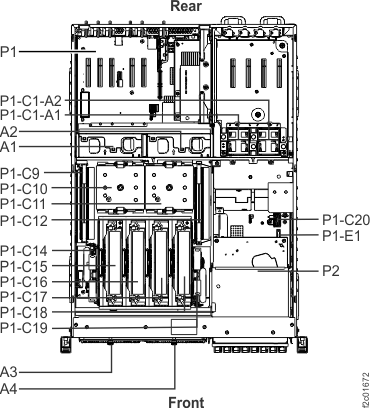
Replace the processor module FRU that contains the processor ID that is deconfigured. See Figure 1.
There are one or two processor modules in a CEC enclosure.
P1-C11 is always present
P1-C10 is optional based on installed features.
Exit this MAP procedure and return to the management console screen that sent you
here.Do a normal repair of the processor module by selecting the next FRU in the FRU
list.The FRU list always lists the P1-C11 location code, even if the P1-C10 processor
module has a deconfigured processor ID. You can use the P1-C11 location code to replace the P1-C10
FRU.
No, go to step 12 (Models 980, 981, 983, 984, 985, 986).
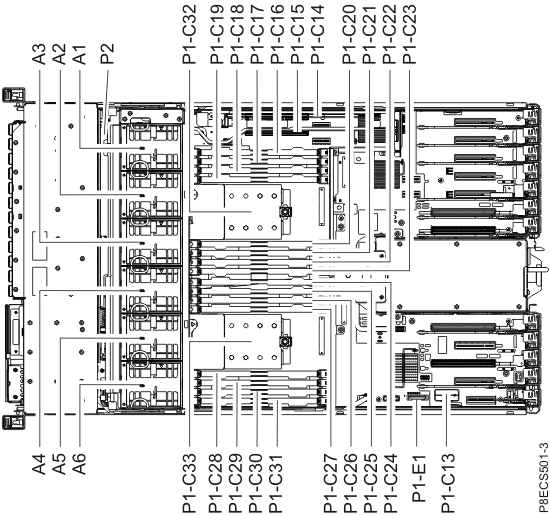
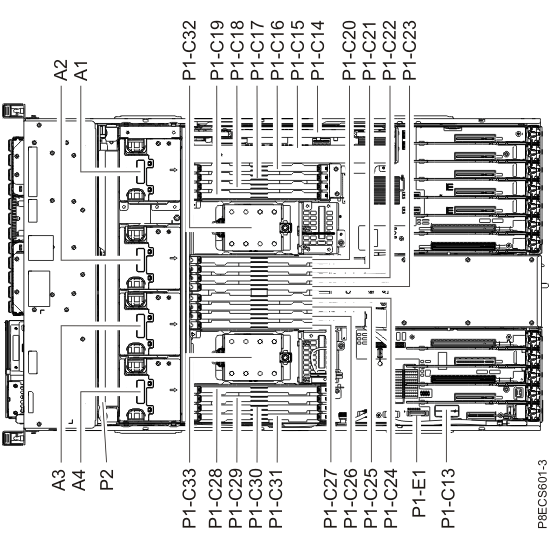
Replace the processor module FRU that contains the processor ID that is deconfigured. See Figure 2 (Models 980, 983, 984) or Figure 3
(Models 981, 985, 986).
There are one or two processor modules in a CEC enclosure.
P1-C32 is always present.
P1-C33 is optional based on installed features.
Exit this MAP and return to the management console screen that sent you here.Do a
normal repair of the processor module by selecting the next FRU in the FRU list.The FRU
list always lists the P1-C32 location code, even when the P1-C33 processor module has a deconfigured
processor ID. You can use the P1-C32 location code to replace the P1-C33 FRU.
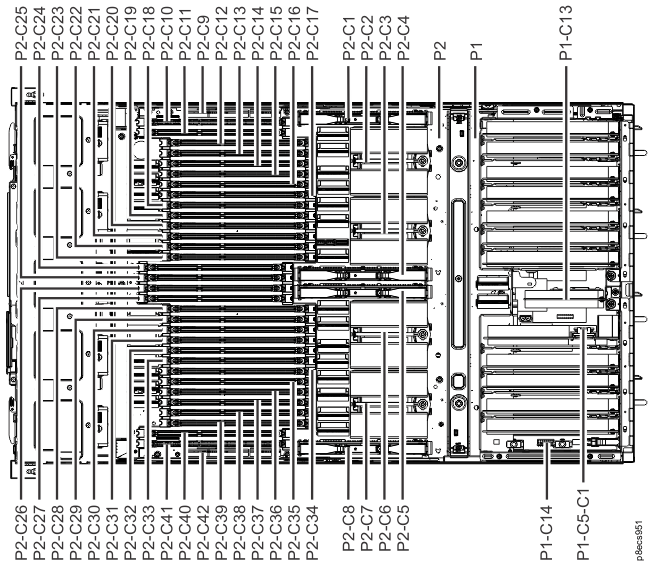
Replace the processor module FRU that contains the processor ID that is deconfigured. See Figure 4 (Models 982, 988).
There are up to four possible processor modules in a CEC enclosure.
P2-C2
P2-C3
P2-C6
P2-C7
Exit this MAP and return to the management console screen that sent you here.Do a
normal repair of the processor module by selecting the next FRU in the FRU list.