Exchange the PPS 208V DDM power module
Before you begin
 Use approved ESD procedures to prevent damage.
Attention:
- This procedure is not a stand-alone procedure. Customer disruption and damage to the hardware might occur when microcode and power boundaries are not in the proper conditions for this service action.
- If a serviceable event FRU repair directed you to this procedure, the microcode and power boundaries are already set.
- If a serviceable event FRU repair did not direct you to this procedure, see MAP1230 Replace a FRU without using a serviceable event.
Notes:
- All the cables and FRUs to be removed must be uniquely identified so they can be reinstalled correctly.
- If an installed earthquake resistance kit prevents you from accessing this FRU, refer to MAP1600.
DANGER
Hazardous
voltage, current, or energy levels are present inside of a component
to which this label is attached. (L001) 
Remove the PPS 208V DDM power module
Procedure
-
Do not use the PPS FAULT LED indicator
 to identify the PPS being
repaired.
to identify the PPS being
repaired.
- When the failing PPS is being repaired, the PPS FAULT LED indicator on the working PPS in
the same rack might be on solid.
The working PPS is indicating that the PPS being repaired is not available for use. - Use the FRU Identify LED indicator
 to identify the PPS being
repaired.
to identify the PPS being
repaired.
Figure 1. LEDs on the PPS (front) 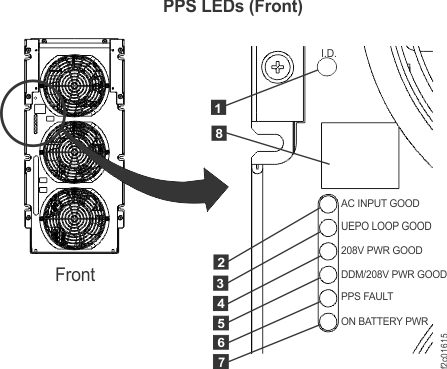
- When the failing PPS is being repaired, the PPS FAULT LED indicator on the working PPS in
the same rack might be on solid.
- To gain full access to the rear of the PPS, unfasten and then rotate the power distribution
units (PDUs) away from the rear of the PPS.
Figure 2. Power distribution units in normal position (rack rear view) 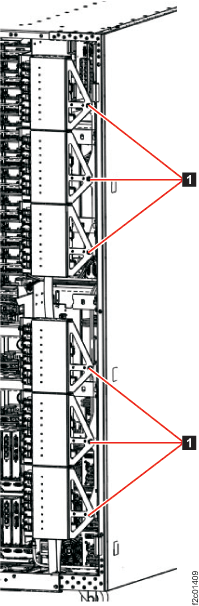
- Remove power and mainline power cord from the PPS.
- On the PPS, at the ac input power module, set the CB00
switch to Off (down).
- Push the two release levers
 .
. - Disconnect the mainline power cord from the ac input
power module.
Figure 3. Remove the ac mainline power cord 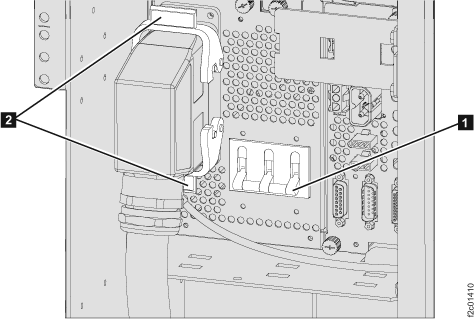
- On the PPS, at the ac input power module, set the CB00
switch
-
At the rear of the PPS that does not contain the module that is being replaced, disconnect the
 PPS-to-PPS communication
cable at the bottom right of the PPS sequencer module (see Figure 4).
Notes:
PPS-to-PPS communication
cable at the bottom right of the PPS sequencer module (see Figure 4).
Notes:- Disconnecting the cable from the PPS that does not contain the module that is being replaced will protect that PPS. Then, when the other end of the cable is disconnected from the PPS containing the module that is being replaced, no pins inside that connector will be able to touch ground and shut down the PPS that does not contain the module that is being replaced.
- This removes the remaining logic power from the PPS containing the module that is being replaced; all PPS LEDs should now be off.
Figure 4. PPS rear view, lower right: PPS-to-PPS communication cable connection 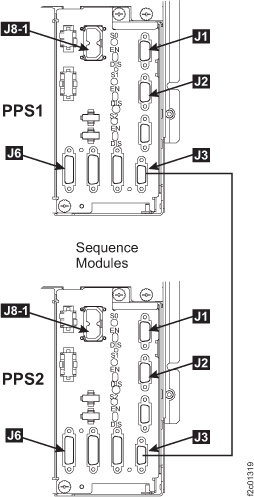
- Remove the PPS 208V DDM power module.
- Remove the screws or (as applicable) from the PPS 208V
DDM power module.
- If the cable routing bracket blocks the module,
remove it. Each bracket is held by two screws that only need to be
loosened, not removed. See Figure 5, .
Figure 5. Cable routing brackets 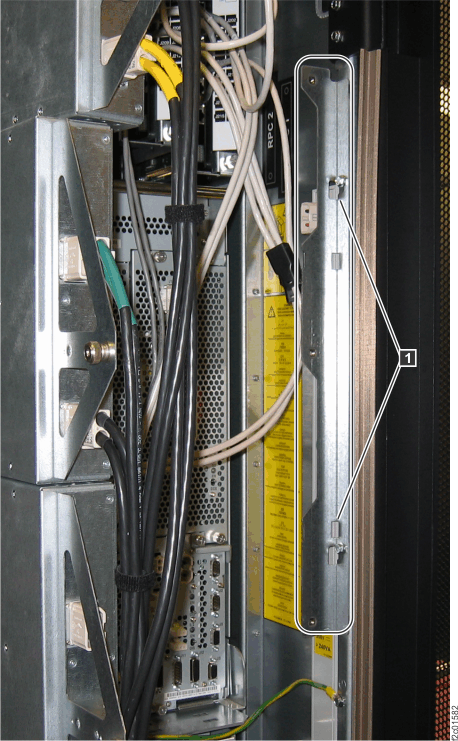
- Remove the PPS 208V DDM power module.
Figure 6. PPS module location codes 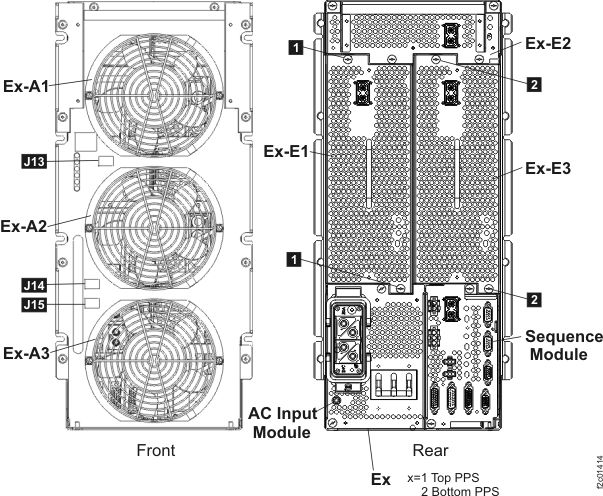
- Remove the screws
Install the PPS 208V power module
About this task
Note: Do
not connect the PDU power cable to the PPS 208V DDM power module.
It will be connected in a separate procedure after the PPS has been
powered on and the module has been verified.
Procedure
-
At the rear of the PPS containing the replacement module, connect the PPS-to-PPS communication cable
at the bottom right of the PPS sequencer module.
-
At the rear of the PPS that does not contain the replacement module, connect the PPS-to-PPS communication cable
at the bottom right of the PPS sequencer module.
Note: One or more of the PPS LEDs may now be lit on the PPS containing the replacement module.
- Connect power.
-
At the PPS, connect the mainline power cord to the ac input power module. Secure it with both
release levers .
- At the ac input power module, set the CB00 switch to
on (up) .
Figure 7. Connect the ac mainline power cord
-
At the PPS, connect the mainline power cord to the ac input power module. Secure it with both
release levers